

|
|||||||
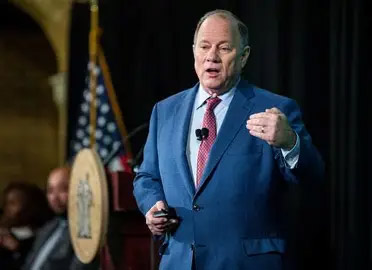
Duggan dishes on data centers, legislative earmarks and ballot proposals for MichMash Former Detroit Mayor and current independent gubernatorial candidate Mike Duggan discussed his bid for governor, opinions on how the state should approach data center and appropriations, and he raised concerns about some of this year's ballot proposals during an interview for MichMash, Gongwer News Service's podcast in partnership with WDET. Duggan said he was running for governor, not on campaign promises, but on his record. "I talk about the 6,000 affordable housing units we built in the city," he said. "I talk about the investment in the city, including in the tech jobs, as well as the manufacturing jobs." Duggan said he thought it was funny that the Michigan Democratic Party was upset about him attacking them when they've spent a lot of time attacking him. "They're the ones last summer that bought billboards calling me corrupt. Then they bought billboards calling me MAGA. Then they bought YouTube ads calling me corrupt," he said. "Then, when I say the Democrats aren't delivering for you, they say, 'Oh, he's being mean to us.'" Part of his frustration with the Democratic trifecta, Duggan said, was that they didn't accomplish anything on affordable housing, securing additional mental health beds or putting money back in schools. "They spread the money around their projects, and here we are in 2026 where they're talking about $1 billion budget hole," he said. "What I'm angry about is that these candidates run on things they say they're going to do, but once they get to Lansing, they do things either to help them keep the majority or get the majority, and I believe most people are fed up with it." Duggan said he'd rather see a competitive bidding process for projects, rather than appropriations tucked into the budget. "Give the money to the Department of Health and Human Services, to a statewide competition, let people propose programs and fund them based on merit," he said. Duggan said Republicans and Democrats are at fault for the problems Michigan is facing. "Most people in Michigan are ready for change," he said. Duggan compared his style of politics to Gov. Gretchen Whitmer's. "She went up to the Oval Office repeatedly," he said, speaking about the mission for Selfridge Air Force Base. "People remember the picture of her with a folder over her face, but the truth of the matter was she was up there, over and over, fighting for Michigan. … I applauded Gretchen Whitmer for putting the jobs of the people of Michigan first, and you work with people who can deliver for you, and I think that's what most people in the state want." Duggan said many people in the state feel forgotten by Lansing. "Lansing is too busy fighting with each other and not watching out for them," he said. Higher education should not be funded out of the School Aid Fund, Duggan said when asked about education funding. "There is no billion-three increase in higher ed," he said. "What the state of Michigan has been doing, Republicans and Democrats together, is they put it into higher ed, then they take $1 billion out of higher ed, and they put in all their little earmarks and their pet projects in the rest of the general fund." He said, if elected, he would reduce the growth of the General Fund by 2% each year, and over five years, put the additional $1 billion back into the School Aid Fund. "Somehow, we get together in Lansing, and we shortchange the children first," he said. "I'm going to reverse that." The higher education budget is nothing but a shell game, Duggan said. "Under Snyder, they found this little loophole that said because the School Aid Fund included education, we could slide it into colleges," he said. "Then, they promptly took that college money, and they put it into a whole bunch of other things in the General Fund. It has been nothing but a shell game." Duggan said he delivered on similar promises in Detroit, such as building the police department and the parks and rec department. Duggan also talked about the property tax cuts being proposed by Republican gubernatorial candidates, but he said none of them had a plan. He said he actually did tax cuts while mayor. "I started with funding the critical services. As soon as we got through with that, we started to do tax cuts," Duggan said. "I'm going to do the same thing in the state of Michigan." Duggan also discussed data centers. He said that he'd like to see a state legal team that's available to every community in Michigan. "These data centers consume a huge amount of power, and in most cases, take major new grids, and you need to make sure that cost does not get passed on to the existing user," he said. "You can do that with the right agreement." Duggan gave no names for who he's looking at for lieutenant governor, but he said the person he chooses will be someone who's "accomplished something special in their lives." "Somebody who loves Michigan and has built something special, because we're going to build," he said. "We've got to change the way we think about state government." Duggan was firmly against the proposal to hold a constitutional convention. "There's too much opportunity for mischief in both extremes if we open that Constitution," he said. "I'll be voting no on that." Duggan said he was less familiar with the details of the citizen-only ballot proposal, but he said if the process was going to make mail-in ballots more difficult, he would not be supportive. "If the process is going to require you, in order to send in an absentee ballot, to somehow find a Xerox machine, Xerox your driver's license, attach it to your ballot and the like, at that point, you create a significant disincentive for folks to participate," he said. As time goes on, Duggan said more people are warming up to the idea of his independent candidacy. "I don't have a club, so I invite everybody to, whether it's the restaurant in downtown Munising, or the convention center in Port Huron, and people show up and usually are laughing because they aren't in the same room with Republicans and Democrats normally," Duggan said. "It starts with curiosity and skepticism and ends up with smiles and people signing volunteer cards."
Cosmetology apprentices would be able to shampoo members of the public in a licensed cosmetology establishment under a bill passed by the House on Thursday. Currently, apprentices are not allowed to offer shampoo services. HB 4908 passed 104-0. "It's so simple we shouldn't even be talking about it," Rep. Angela Rigas, R-Alto, the bill sponsor said. "We want parity and fairness." The House also passed HB 5249 , which would create a new type of ambulance operation license called an "ambulance operation adaptive care license." It passed 103-1. Rep. Jaime Greene, R-Richmond, was the only no vote. Greene said she thought the change would lower the incentive to have a higher licensure. "I have higher care from an EMS provider because EMS chooses to have a higher level than somebody else," she said. "Especially in rural areas where you are far from a hospital, you want to have the highest level of care possible." The bill sponsor, Rep. Dave Prestin, R-Cedar River, said during committee testimony on the bill that allowing people with higher skill levels to use them by offering a new type of ambulance operating license would incentivize people to get additional training. Finally, the House passed HB 5343, that would allow for more booze in alcoholic beverages sold in stores. The legislation would allow packaged mixed spirit drinks to contain up to 21% alcohol by volume. The current limit is 13.5%. The bill contains a carve out for bottles and distributors. "It was something the industry was asking for," bill sponsor Rep. Joe Aragona, R-Clinton Township, said. "If we can open up the market and allow you to make money, I'm not going to harm another company, which is why we had the carve out." 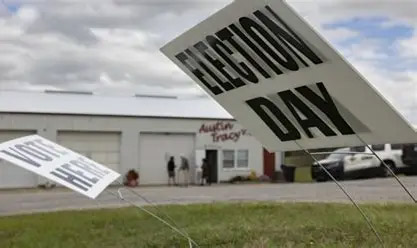 Attempt to change August primary to May clears first legislative hurdle Attempt to change August primary to May clears first legislative hurdle
Legislation that would change Michigan's statewide primary election date from August to May was reported by a Senate committee on Wednesday, whose chair said he believes it could have the necessary bipartisan support to reach the governor's desk. The Senate Elections and Ethics Committee moved an eight-bill package that would move the August primary election to May with the statewide primary in even-numbered years. "We believe that this can go all the way. This is something that's been floated around here in the Capitol for many years," Sen. Jeremy Moss, D-Bloomfield Township, told reporters. Moss said he believed there should be bipartisan support for the proposed changes, adding his hope is that the bill package sees floor votes in the Senate soon. "Every state around us has an earlier primary, including Illinois, (whose) primary is next week, so we are actually out of step with the rest of the region," Moss said. "We're one of the latest primaries in the country." The main bill in the package, SB 691, would move the August primary to May. A primary election would also be permitted on the February election date. Currently, the state only holds February elections if there is a presidential primary. As reported, the bills would be effective January 1, 2028, giving clerks time to prepare for the changes. "With those items that we did to strengthen post-election work in August, and what we've done to increase early voting and increase access to absentee ballots for November, it's just a tight timeline for clerks to end one election and begin another, and we're giving them more space to do so," Moss said. Under SB 697, the required petition signatures necessary for those seeking statewide office would be reduced from 30,000 to 60,000 signatures to 15,000 and 30,000 signatures. Changes in SB 698 would require all committees to follow the same campaign finance disclosure schedule. Pre-election campaign finance statements would be eliminated and instead require four statements a year, regardless of year – January 25, April 25, July 25 and October 25. In election years, candidates currently must file statements on January 31, just before the August primary, just after the August primary, just before the November election and just after the November election. The remaining bills in the package (SB 692, SB 693, SB 694, SB 695 and SB 696 ) revise various statutes to align with the election date changes proposed in SB 691. Two supplementary bills, SB 814 and SB 815, were also reported by the committee. The bills would amend the financial disclosure deadline for candidates for elected office and public officials from May 15 to April 15. Members voted 5-1 on SB 691 and SB 815, with Sen. Ruth Johnson, R-Groveland Township, as the vote in opposition. The votes on the remaining bills were 6-0. Prior to the votes, Johnson criticized the option to hold February elections under SB 691. She questioned holding an election in the middle of winter, citing low turnout. "We're going to create more work for our clerks, and we know it's going to get a low turnout," Johnson said. "I thought the whole idea was to get a high turnout, to make a convenient date. So I'm very much against changing these days and adding on three more elections when we already have enough." Before the committee for testimony only was SB 820, which would allow the permitted population of a consolidated election precinct from 5,000 to 15,000 active registered electors Current law allows local governments or school districts divided by two or more election precincts to consolidate those districts by local resolution. This provision does not apply to a general November election or a primary election that takes place before that election or other statewide or federal elections. Sen. Paul Wojno, D-Warren, said municipalities would not be required to consolidate precincts under his bill. He said it could provide savings to local municipalities of an estimated $3,900 per precinct. DCD MUNICIPAL MINUTE  House Approves Bill to Restore “Open and Obvious” Liability Protections — Key Update for Businesses and Local Governments Business owners and municipal officials should be aware of legislation advancing in the Michigan Legislature that would restore an important legal protection for property owners that has been in place for decades. The Michigan House of Representatives this week approved House Bill 4582 by a vote of 58–48, legislation that would reinstate Michigan’s long-standing “open and obvious” premises liability doctrine by codifying it into state law. Background on the Court Decision For many years, Michigan courts applied the open and obvious doctrine, which generally held that property owners were not liable for injuries caused by hazards that were clearly visible and that a reasonable person would be expected to notice and avoid, such as ice, standing water, uneven pavement, or other readily apparent conditions. In the 2001 case Lugo v Ameritech Corp Inc, the Michigan Supreme Court ruled that a property owner’s duty of care does not extend to conditions that are open and obvious. However, in 2023 the Court overturned that precedent, holding that property owners may still have a duty to protect against hazards even when they are visible. That decision significantly expanded potential liability exposure and left Michigan as one of a small number of states without a clear open-and-obvious defense. Since that ruling, local governments, businesses, and insurers have raised concerns about increased litigation risk, higher insurance premiums, and greater uncertainty when managing public property, commercial facilities, and housing. What House Bill 4582 Would Do House Bill 4582 would codify the open and obvious doctrine in statute and largely restore the legal framework that existed prior to the 2023 court decision. Under the bill: Property owners would still have a duty to use ordinary care to protect people on their property. However, owners would generally not be liable for injuries caused by conditions that a person knew about or that would be discovered by a reasonably careful person upon casual inspection. The bill would still require reasonable precautions when special circumstances make an otherwise open and obvious hazard unusually dangerous. Bill sponsor Jerry Neyer (R-Shepherd) told colleagues during floor debate that the court’s ruling created uncertainty for employers and property owners across the state. “Small businesses, farms, retailers, restaurants and property owners across Michigan are facing legal uncertainty without the previous clear and reliable standards that open and obvious provided,” Neyer said. “Higher liability exposure earns higher insurance rates and premiums. Higher insurance rate premiums mean higher cost of operation — and that means less money going to wages, investments, and expansion.” Impact on Municipalities For cities, villages, townships, and counties, the change could be significant. Local governments routinely maintain sidewalks, streets, parks, public buildings, and recreation facilities where slip-and-fall and trip-and-fall claims can occur. Since the 2023 ruling, many communities have reported concerns about rising liability exposure and pressure on insurance and risk-pool costs. Restoring the open-and-obvious standard could help: *Reduce exposure to premises-liability lawsuits *Provide clearer guidance for courts and insurers *Stabilize municipal insurance and risk-management costs *Limit taxpayer exposure to claims involving visible hazards Impact on Businesses and Property Owners Business organizations strongly supported the bill, arguing that the prior standard allowed courts to dismiss meritless claims early and avoid costly litigation. The National Federation of Independent Business Michigan chapter said the change is needed to restore predictability. State Director Amanda Fisher noted that without the doctrine, judges and juries must decide case-by-case whether an obvious hazard still created an unreasonable risk, increasing legal costs for employers and property owners. Other business and legal reform groups also supported the measure, saying Michigan became a national outlier after the 2023 court decision and more vulnerable to lawsuits than neighboring states. Next Steps The legislation now moves to the Michigan Senate for consideration. If enacted, the bill would restore a familiar legal standard that governed premises liability in Michigan for decades and could have direct effects on municipal operations, insurance costs, housing development, and everyday business activity across the state. Local officials and business owners are encouraged to monitor the bill closely, as its final outcome may directly affect liability exposure, budgeting, and risk-management practices going forward. DCD OUT & ABOUT
DCD IS A FULL-SERVICE, BI-PARTISAN, MULTI-CLIENT LOBBYING FIRM REMEMBER ALL OF DCD'S SERVICES: ARTICLES OF POLITICAL INTEREST:
Group halts 'tax the rich' ballot effort to raise funds for Michigan schools - Bridge Michigan Michigan to clerks: Don't use jury pools to search for noncitizen voters - Bridge Michigan 5 things to know as Michigan lawmakers try again on dam safety reforms - Bridge Michigan Michigan fake electors plan to sue Attorney General Nessel for wrongful prosecution - mlive.com Michigan House passes bills to require millage votes in November How to see Macomb County’s scanned ballot images from 2025 election PARTING WISDOM: March is National Reading Month  Doing Things Differently DCD is rebranding, and our bottom line is your bottom line. We are striving to create and foster strong relationships with clients and lawmakers, deliver results with strong ethics and class, but above all else, out-hustle and out-smart our competition every day to be the very best. We’re making chess moves while others are playing checkers. Everything we do is with you in mind, we’re doing things we’ve never done before and aggressively pursuing opportunities. The time is now. DCD has taken our firm to the next level and your involvement and investment paired with our knowledge and expertise is going to launch the great state of Michigan forward. |
|||||||
|
|||||||
 More shampoo and more booze, House OKs bills for regulatory changes




Contact Us
Address
Phone
Copyright © Dunaskiss Consulting and Development Inc.


