
|
|||||||

A New Political Landscape in Lansing: Both Parties Prepare for a New Chapter Michigan's 2026 midterm elections have produced a significant shift in the state's political landscape, and the leadership decisions made in Lansing during the days immediately following the election offer an early indication of how the next legislative session may unfold. With Democrats retaining the governor's office and expanding their majorities in both chambers, Michigan is preparing for another Democratic governing trifecta beginning in January 2027. But beyond the change in party control, both Democrats and Republicans have selected new legislative leaders, signaling a transition in personalities, priorities, and potentially the way business gets done at the Capitol. For municipalities, businesses, healthcare providers, nonprofits, and other organizations that rely on state government, these changes are more than political headlines. They will shape the relationships, legislative priorities, budget decisions, and funding opportunities that matter to communities across Michigan. Democrats: A Stronger Majority and an Opportunity to Govern The most consequential change is the return of unified Democratic control. Governor-elect Jocelyn Benson will succeed Governor Gretchen Whitmer in January, while Democrats enter the 2027-2028 legislative session with a 63-47 majority in the House and a 23-15 majority in the Senate. The expanded House majority is particularly significant. Democrats previously governed with a narrow margin, leaving little room for internal disagreements or defections on major legislation. In the House, members selected Representative Ranjeev Puri of Canton as the next Speaker of the House. Puri, currently serving as House Minority Leader, will make history as the first Indian-American to hold the speakership. His leadership team will include Representative Laurie Pohutsky of Livonia as Speaker Pro Tempore, Representative John Fitzgerald of Wyoming as Majority Floor Leader, Representative Jennifer Conlin of Ann Arbor Township as Majority Whip, and Representative Stephanie Young of Detroit as Caucus Chair. Puri's early comments suggest that Democrats intend to use their stronger majority to pursue a more ambitious policy agenda, while emphasizing measurable results rather than simply the volume of legislation passed. Affordability, household incomes, population growth, healthcare access, and rising utility costs have emerged as early areas of emphasis. The Senate will also have a new majority leader. Senator Darrin Camilleri of Trenton was selected to lead the Democratic caucus, succeeding Senator Winnie Brinks, who is expected to become Michigan's next lieutenant governor. Camilleri, a former teacher representing a Downriver district, has emphasized the need to address the cost of living and deliver meaningful policy results. Senator Kevin Hertel of St. Clair Shores will serve as Majority Floor Leader, giving the chamber leadership team a strong presence from Southeast Michigan. The Democratic leadership now faces a different challenge than it did during its previous period of unified control. With larger majorities, the party has more flexibility to advance legislation, but it will also bear greater responsibility for the results. Voters will expect progress on the issues that dominated the campaign, particularly affordability, economic opportunity, infrastructure, and access to essential services. Republicans: A Change in Direction and a New Minority Strategy Republicans, meanwhile, are entering a period of reassessment following significant losses in the election. The party not only surrendered its House majority but also saw Democrats strengthen their position in the Senate and win the governor's office. The most notable leadership change came in the House, where Republicans selected Representative Tom Kunse of Clare to lead their caucus as Minority Leader. Kunse replaces outgoing Speaker Matt Hall, who sought to retain the leadership position but was not selected by his colleagues. The choice of Kunse may signal a change in the Republican approach to the minority. Hall's tenure was characterized by an aggressive legislative strategy and frequent confrontations with Democratic leadership. Kunse has indicated a more collaborative posture, emphasizing that the parties should be able to work together where their interests align. In comments following his selection, Kunse offered a particularly telling observation: “Democrats are not the enemy. Being 45th in education is the enemy.” He also identified affordability, education, and healthcare costs as issues where Republicans could find common ground with the incoming majority, while making clear that the party would continue to oppose policies it believes are harmful to Michigan families. Representative Mike Harris of Waterford will serve as House Minority Floor Leader, while Representative Rachelle Smit of Martin was selected as Assistant Minority Leader. These appointments give the House Republican caucus a new leadership structure as it begins the work of rebuilding its political position. In the Senate, Republicans selected Senator Roger Hauck of Mount Pleasant as Minority Leader. Hauck has also expressed an interest in finding areas of agreement with Democrats, particularly on education, affordable housing, and healthcare costs. Senator Thomas Albert of Lowell will serve as Senate Minority Floor Leader. The Republican challenge is twofold: holding the new Democratic majority accountable while demonstrating that the party can offer constructive alternatives and work across the aisle when appropriate. The leadership selections suggest that Republicans understand the need to reassess their approach, rebuild their caucuses, and reconnect with voters. What Does This Mean for Michigan's Communities? For local governments and organizations doing business with the state, the change in leadership presents both opportunities and challenges. A unified Democratic government can potentially move legislation and funding initiatives more efficiently than a divided government. That may create opportunities in areas such as infrastructure, road improvements, water and sewer systems, housing, economic development, public safety, and community revitalization. However, the ability to advance legislation does not necessarily mean every community or project will receive the attention or funding it seeks. Priorities will compete, available resources will remain limited, and the details of the state budget will ultimately determine where dollars are directed. Municipalities should pay particular attention to the development of the new House and Senate committee structures. Committee chairmanships and assignments will determine which legislators have the greatest influence over specific policy areas and appropriations. Those decisions are expected to continue through December and January, making the next several weeks an important period for identifying the lawmakers who will shape the issues most relevant to local communities. The transition also reinforces the importance of maintaining relationships with both parties. While Democrats will control the legislative agenda, Republicans will continue to represent substantial portions of Michigan and will have an important role in legislative debate, oversight, and the development of bipartisan initiatives. Local priorities should not become dependent on a single party or a handful of legislative relationships. For communities seeking state appropriations, grant opportunities, infrastructure support, or assistance with redevelopment initiatives, early engagement will be particularly important. Establishing relationships with incoming leadership, committee members, and newly elected legislators can help ensure that local priorities are understood before the legislative and budget processes are fully underway. The Work Begins in January Michigan's new legislative leadership will inherit a state facing familiar but increasingly urgent challenges: economic competitiveness, population growth, aging infrastructure, education, healthcare costs, housing affordability, and the financial pressures facing local governments. The Democrats have an opportunity to demonstrate that unified control can produce meaningful results. Republicans have an opportunity to redefine their role, develop a constructive minority strategy, and rebuild public confidence. Both parties will be judged not by the leadership titles they have secured, but by what they accomplish for the people and communities they represent. For those who work with state government, the message is straightforward: a new political landscape requires renewed relationships, a clear understanding of legislative priorities, and a proactive approach to advocacy. At Dunaskiss Consulting & Development, we will be closely monitoring the transition, the development of the new committee structure, and the policy and funding priorities that emerge as the 104th Legislature prepares to convene in January. Understanding who is making decisions—and where opportunities exist to advance our clients' priorities—will be essential in the months ahead. The election may be over, but in Lansing, the next chapter is just beginning. 
Affordability Moves to the Top of Lansing's Agenda: Seven Ideas Democrats May Pursue Michigan Democrats won the 2026 elections with a clear message: lowering the cost of living must be a priority. From Governor-elect Jocelyn Benson to incoming legislative leaders and newly elected members of Congress, the promise to put more money in the pockets of Michigan families was central to the party's campaign. Now comes the harder part: turning campaign promises into policy. A recent report by Bridge Michigan examines seven potential approaches the incoming Democratic administration and Legislature could pursue to address affordability. The proposals range from wage and tax-credit initiatives to changes in trade policy, road funding, healthcare, and utility regulation. While each offers a potential avenue for relief, the report also highlights the fiscal, political, and jurisdictional obstacles that could make implementation difficult. 1. Raising Wages and Household Income One approach is to address affordability not only by reducing expenses but also by increasing what Michigan residents earn. Benson has proposed a $60,000 minimum salary for teachers, while incoming House Speaker Ranjeev Puri has identified Michigan's lagging household median income as an issue requiring attention. Further increases in worker protections, minimum wages, and workforce participation could also be considered. However, previous minimum-wage negotiations demonstrated how difficult these proposals can be, particularly when they affect employers and small businesses. 2. Expanding Tax Credits and Family Supports Benson has expressed interest in expanding the Rx Kids program and creating a $5,000 caregiver tax credit. Other possibilities include expanding childcare scholarships and increasing the availability of childcare providers. These proposals could provide meaningful assistance to working families and caregivers, but their cost will depend in part on state revenue and potential changes in federal support for Medicaid and food assistance programs. Proposals to raise taxes on higher-income residents have also entered the discussion as a possible funding source. 3. Revisiting Federal Tariff Policy Tariffs were a prominent issue in the 2026 campaign, with Democrats arguing that import taxes and retaliatory trade measures have increased costs for consumers and businesses. Michigan's manufacturing sector and businesses dependent on international supply chains are particularly exposed to changes in trade policy. Congressional Democrats are expected to pursue efforts to revise or roll back portions of President Trump's tariff agenda. However, trade policy is primarily a federal responsibility, and meaningful changes will require action in Washington. 4. Repairing Michigan's Relationship with Canada For Michigan, the relationship with Canada is especially important. Trade disruptions, retaliatory tariffs, and reduced cross-border tourism have affected businesses on both sides of the border. A more cooperative relationship could benefit manufacturers, agricultural interests, retailers, tourism operators, and communities throughout the state. While the governor can advocate for improved relations and work with Canadian counterparts, formal trade agreements and tariff policy remain largely within federal jurisdiction. 5. Considering a Temporary Gas Tax Reduction With gasoline prices remaining a concern for Michigan households, Benson has indicated an openness to considering a temporary reduction in the state's gas tax. Michigan currently has one of the nation's higher fuel-tax rates. The challenge, however, is that those revenues are a primary funding source for road and infrastructure improvements. Suspending or reducing the tax could provide short-term relief to drivers, but it would leave lawmakers with a difficult question: how would the state replace the revenue needed to maintain and repair its roads? Any reduction would have to be weighed against the consequences for local and state transportation funding. 6. Addressing Healthcare Costs Healthcare affordability is another major area of focus. Potential state initiatives include establishing a state health plan, creating a prescription drug affordability board, and exploring ways to address gaps in coverage if federal healthcare subsidies or Medicaid funding are reduced. Benson and legislative Democrats have previously supported a prescription drug board that could establish limits on certain medication costs. More expansive proposals, including a federal Medicare-for-All system championed by incoming U.S. Senator Abdul El-Sayed, would require substantial changes in federal policy and financing. 7. Examining Utility Rates and Data Center Impacts Finally, Democrats are expected to focus on electricity costs, utility reliability, and the growing demand for energy associated with large data centers. Benson has advocated for reforms to the utility rate-setting process, stronger protections for customers experiencing prolonged outages, and greater accountability between utility profits and service reliability. She has also proposed a review of Michigan's electric grid and a home-energy assistance program to help residents improve efficiency and manage heating and cooling costs. These issues will be particularly important as Michigan considers attracting new industrial investment and data center development while protecting existing ratepayers from rising energy costs. The Challenge: Turning Promises into Results The seven proposals illustrate the breadth of the affordability agenda facing Michigan's incoming Democratic leadership. They also reveal a central challenge: many of the most visible promises involve competing financial priorities, limited state resources, and decisions that cannot be made in Lansing alone. Some initiatives could be advanced through state legislation or administrative action. Others depend on federal policy, cooperation with the Trump administration, or additional revenue. Still others, such as a gas tax holiday, could provide immediate relief while creating longer-term funding problems for essential infrastructure. For municipalities, these debates deserve close attention. Changes to transportation funding, utility regulation, housing and childcare programs, healthcare policy, and state revenue priorities can have direct consequences for local budgets, capital improvement plans, economic development strategies, and the services communities provide. State decisions can create new opportunities for local investment, but they can also introduce new costs, restrictions, or uncertainty. The incoming administration will have the advantage of unified Democratic control in Lansing, but that does not eliminate the practical challenges of governing. A larger legislative majority may make it easier to advance an agenda, but it does not create additional revenue or resolve disagreements over how limited resources should be allocated. Ultimately, voters will judge the new administration on whether their everyday expenses become more manageable. The campaign promise was straightforward: make Michigan more affordable. Delivering on that promise will require difficult choices about taxes, spending, infrastructure, healthcare, energy, and the state's economic competitiveness. For Michigan's communities and the organizations that serve them, the development of this agenda will be an important part of the 2027 legislative landscape. DCD will continue to monitor these proposals and assess how emerging state policies may affect our municipal and organizational clients. 
Women To Hold Record Numbers Of Seats In House, Senate Women will hold a record number of seats in both chambers of the Michigan Legislature beginning in January, with 16 serving in the Senate and 46 in the House. Ten incoming female senators will join six returning women, bringing women’s representation to 42.1% of the 38-member Senate. That surpasses last year’s total of 14 female senators. In the House, 20 incoming women will join 26 returning female lawmakers. The resulting 46 women will account for 41.8% of the 110-member chamber, exceeding last year’s total of 44. Together, women will hold 62 of the Legislature’s 148 seats, or 41.9%, compared with 58 last year. The numbers mark a substantial change from the Legislature Lorraine BEEBE entered in 1967. The Dearborn Republican was only the third woman elected to the Michigan Senate and the first Republican woman to serve in the chamber. Back then, in order for me to use the facilities, the sergeants-at-arms had to make sure there were no men in the chamber's bathroom before they gave the all-clear for her Beebe enter. That's because there was no bathroom for women in 1967. Sixty years after Beebe took office, women will hold more than two out of every five seats in both the House and Senate, according to the Center for Women and Politics. Readers only need to go to 1982 to find the last year with no female senators. In 1976, only 9 of the 110 House members were women. 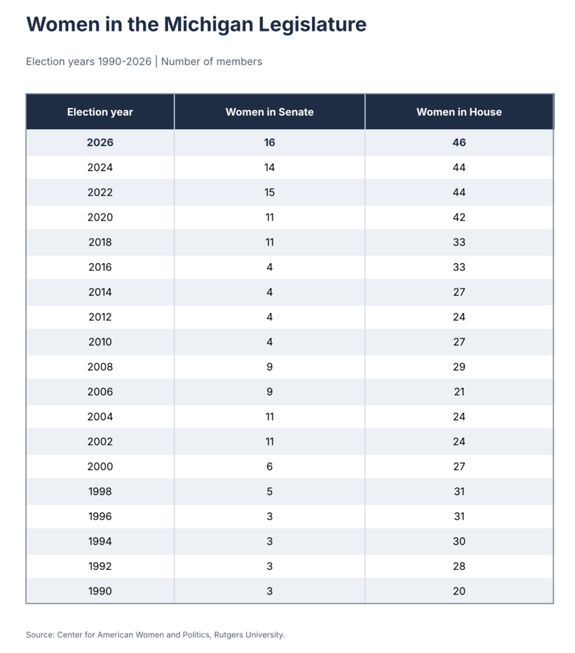 After the Election: What's Next for Michigan Businesses and Municipalities?  Michigan's November election has fundamentally changed the political landscape in Lansing. Democrats have secured control of the governor's office and both chambers of the Legislature, establishing a governing trifecta that will shape state policy beginning in January 2027. For Michigan's business community and local governments, the implications extend well beyond a change in party leadership. The election delivered Democrats a 63-47 majority in the Michigan House and expanded their advantage in the Senate to 23-15. Governor-elect Jocelyn Benson will take office in January, joining a Legislature in which Democrats will have considerably more room to advance their agenda than they had during the previous session. Democrats also maintained their majority on the Michigan Supreme Court and secured victories in other statewide offices. The Michigan Chamber of Commerce's post-election analysis makes one thing clear: the next legislative session could bring substantial changes to Michigan's business climate. The Chamber has identified several areas that employers should be watching, including labor policy, taxation, environmental regulation, and restrictions on corporate political activity. Additional analysis from the Detroit Regional Chamber points to data center development, utility costs, and local government authority as issues likely to receive significant attention. For municipalities, these same policy debates will have direct consequences for economic development, zoning, infrastructure, local revenue, and the ability to attract and retain employers. A New Labor Policy Landscape One of the most consequential proposals under discussion is the potential repeal of Michigan's Local Government Labor Regulatory Limitation Act, commonly known as the "Death Star" law. The law currently restricts local governments from imposing certain employment requirements on private employers, including local minimum-wage standards and employee benefits mandates. Repealing it would give cities, villages, townships, and counties greater authority to establish their own labor requirements. For municipalities, this could represent a significant expansion of local regulatory authority. Communities would have greater flexibility to address workforce issues and establish policies they believe reflect local priorities. However, it could also create a patchwork of employment regulations across Michigan, complicating compliance for businesses operating in multiple jurisdictions. Other labor proposals likely to receive attention include making striking workers eligible for unemployment benefits, changes to independent-contractor classifications, restrictions on noncompete agreements, expanded pay-transparency requirements, and paid family leave. The implications for employers are substantial. Changes to unemployment eligibility, for example, could increase costs through Michigan's employer-funded unemployment insurance system. Expanded employment mandates could also affect hiring, compensation, and workforce planning. Municipal leaders should recognize that greater local authority may bring new policy opportunities, but it will also require careful consideration of the economic consequences for existing businesses and future development prospects. Taxes, Revenue, and Michigan's Competitiveness Tax policy will be another major area to watch. During the campaign, Democrats discussed potential changes to Michigan's revenue structure, including a graduated income tax and increases in corporate taxation. Governor-elect Benson has also discussed establishing a blue-ribbon commission to examine how the state generates revenue and finances its priorities. The central question will be how the incoming administration intends to pay for its affordability and spending commitments. Proposals involving childcare, healthcare, paid family leave, infrastructure, and other public services will require sustainable funding sources. For businesses, the concern is whether additional taxes or regulatory costs could undermine Michigan's ability to compete with neighboring states for investment, jobs, and talent. Michigan already faces challenges involving population growth, workforce participation, educational achievement, and per-capita income. Any new revenue strategy will need to be evaluated against its potential impact on economic growth. For municipalities, state tax policy is equally important. Changes to the business climate can influence development decisions, property values, employment, and the local tax base. Communities seeking to attract new employers or redevelop commercial and industrial properties will need to understand how changes in state policy affect their competitive position. Environmental Regulation and the Future of Development Environmental policy is expected to receive renewed attention under unified Democratic control. One proposal identified by the Michigan Chamber is a renewed "Polluter Pay" framework, which could expand environmental liability for businesses responsible for contamination. The issue is particularly relevant to communities with industrial histories, brownfield properties, and redevelopment opportunities. Michigan has made substantial progress using brownfield programs and other redevelopment incentives to return underutilized properties to productive use. Changes to environmental liability standards could affect the cost, timing, and feasibility of those projects. Municipalities should pay close attention to how any new legislation addresses existing contamination, responsible parties, liability protections, and the availability of redevelopment incentives. Strong environmental standards and responsible redevelopment are not mutually exclusive, but the rules must provide enough certainty for communities and private investors to move projects forward. Data center development will also be a significant policy debate. As Michigan competes for investment in emerging technology and digital infrastructure, questions involving water consumption, electricity demand, utility rates, tax incentives, zoning, and community engagement are becoming increasingly important. Governor-elect Benson has called for a moratorium on new data center development, while incoming legislative leaders have expressed interest in additional regulatory requirements. These could include greater public disclosure, water-use standards, prevailing-wage requirements, and restrictions on agreements that limit public access to information. For local governments, the issue presents both opportunity and risk. Data centers can bring substantial private investment and potentially expand the local tax base, but they also raise legitimate questions about infrastructure capacity, water resources, energy costs, and the long-term interests of residents. Communities considering these projects will need to balance economic development opportunities with responsible planning and public engagement. The decisions made in Lansing could significantly influence how much authority local officials retain over the process. Utility Costs and Infrastructure Energy affordability is likely to become a central component of the new administration's agenda. Democrats have identified utility costs and reliability as important concerns, while the growing demand for electricity from data centers and industrial development adds another layer of complexity. For businesses, energy costs are a significant component of operating expenses and can influence decisions about expansion or relocation. For municipalities, utility infrastructure is essential to virtually every major development initiative, from new housing to industrial parks and commercial redevelopment. Any changes to utility regulation, energy generation, or infrastructure financing will have implications for local economic development strategies. Communities should be prepared to engage with state regulators, utilities, and legislators as these proposals take shape. The same is true for transportation and public infrastructure. Michigan's roads, water systems, wastewater facilities, and public buildings require sustained investment. State policy and appropriations decisions will help determine whether communities can advance the capital improvement projects necessary to support growth. Corporate Advocacy and Government Transparency The Michigan Chamber has also identified potential restrictions on corporate political activity and issue advocacy as an area of concern. Voters approved Proposal 2, which establishes new campaign finance restrictions and disclosure requirements affecting regulated utilities, certain government contractors, and related parties. The measure adds another layer of compliance considerations for organizations that participate in Michigan's political and public-policy processes. For businesses and organizations, understanding the boundaries of permissible political contributions, issue advocacy, and government engagement will be increasingly important. For municipalities, transparency and public accountability will remain essential as communities work with private partners on development agreements, infrastructure projects, and other public-private initiatives. The broader lesson is that organizations should not wait until legislation is enacted to understand how proposed changes may affect their operations and relationships with government. What Municipalities Should Be Doing Now While the full legislative agenda remains under development, the transition period provides an important opportunity for local governments to prepare. Municipal officials should begin reviewing their adopted capital improvement plans, infrastructure priorities, economic development strategies, and pending redevelopment projects. Communities should identify which initiatives may benefit from new state policies or funding opportunities and which could be affected by changes in labor, environmental, tax, or utility regulations. It will also be important to establish relationships with the incoming administration, legislative leadership, committee chairs, and newly elected representatives. Committee assignments and the development of the new administration's First 100 Days agenda will provide a clearer picture of where policy and funding priorities are likely to emerge. For businesses, the same principle applies. Employers should evaluate how potential changes to labor requirements, taxation, environmental compliance, and energy policy could affect their operations. Early engagement with policymakers and business associations can help ensure that the practical consequences of proposed legislation are understood before decisions are made. The Election Is Over. The Policy Work Is Just Beginning. Michigan's new political landscape presents both opportunities and challenges. Unified Democratic control may allow the incoming administration and Legislature to move legislation more efficiently, but it does not eliminate the difficult choices surrounding state finances, economic competitiveness, and the competing priorities of Michigan's communities. The challenge for the new leadership will be to deliver on campaign promises without creating policies that discourage investment, increase the cost of doing business, or make it more difficult for communities to grow. For Michigan's businesses and municipalities, the challenge is to remain engaged, informed, and prepared. The next two years will bring important decisions affecting how communities develop, how employers operate, and where state resources are directed. At Dunaskiss Consulting & Development, we believe that successful advocacy begins well before legislation reaches the governor's desk. Understanding the new political environment, establishing relationships with decision-makers, identifying emerging funding opportunities, and communicating local priorities will be essential to helping our clients navigate the changes ahead. Regardless of which party holds power, Michigan's communities and employers need a seat at the table. The work of ensuring that their voices are heard begins now. DCD OUT & ABOUT
A New Community Destination in Hazel Park! 
DCD Partners Jake German and Justin Dunaskiss were pleased to attend the ribbon-cutting ceremony for the new Jan Parisi Art Park in the City of Hazel Park. DCD, in partnership with Detroit-based architectural firm Archive DS, served as consultants to the city on this innovative placemaking project. Designed to bring new energy and vibrancy to the community, the Art Park will feature rotating art installations throughout the year and create a welcoming new “third place” for residents and visitors to gather, connect, and experience public art. We are proud to have played a role in helping Hazel Park bring this vision to life and look forward to seeing the Art Park become a lasting community asset. Great communities are built through great ideas, strong partnerships, and a commitment to bringing projects from concept to reality. DCD IS A FULL-SERVICE, BI-PARTISAN, MULTI-CLIENT LOBBYING FIRM REMEMBER ALL OF DCD'S SERVICES: ARTICLES OF POLITICAL INTEREST:
DTE, Consumers Energy and free speech group file lawsuits over Michigan Proposal 2 - mlive.com Michigan GOP reckons with Trump, leadership revolt after election drubbing - Bridge Michigan 5 Michigan cities voted to create ‘health action’ boards. Now what? - Bridge Michigan Michigan’s El-Sayed pitches ‘TrumpCare’ as Democrats seek deals with president - mlive.com PARTING WISDOM:
Opinion: The Red Scream: A Warning for Republicans Beyond the Trump Presidency By: Jake German The 2026 midterm elections were not simply a bad night for Republicans. They were a warning—one that echoed in places where the GOP had come to believe its political foundation was secure. From Texas to Appalachia, voters who helped put Donald Trump in the White House turned away from the Republican Party in numbers that should concern anyone interested in the future of American conservatism. Alex Castellanos, who has worked on six Republican presidential campaigns, recently popularized the notion of the “Red Scream," arguing that what we observed on election night was not merely a blue wave rolling through the traditional battleground states. It was an unmistakable expression of frustration from voters who had once embraced Trump’s promise to shake up Washington, challenge the political establishment, and put working Americans first. In state after state, many of those same voters concluded that the administration had failed to deliver the economic relief and practical results they expected. Texas was perhaps the most consequential example. A state Republicans have long treated as a dependable foundation of their national electoral strategy delivered major victories to Democrats, including the governorship and a U.S. Senate seat. The results were especially striking because they came in a state Trump carried comfortably just two years earlier. The political shift was not confined to suburban moderates or traditionally Democratic urban centers. Rural communities and working-class voters—groups central to Trump's political coalition—also moved away from the GOP. The same pattern appeared across parts of Appalachia and the broader rural heartland. In states such as Ohio, Iowa and elsewhere, Democrats made gains in communities that Republicans had increasingly considered their own. These were not necessarily voters who had become progressive Democrats overnight. Many were expressing dissatisfaction with the cost of living, economic uncertainty, and a sense that Washington's political battles had taken priority over the concerns of ordinary households. Some changed their votes; others simply declined to turn out for Republican candidates. Either way, the result was damaging. That distinction matters. Trump's appeal was built in part on a promise to represent people who believed both parties had ignored them. But a political coalition built around frustration and disruption can be difficult to sustain when voters begin to feel that the disruption itself has become the problem. Republicans cannot assume that voters who supported Trump in 2016, 2020 or 2024 will remain loyal regardless of the administration's performance. Political allegiance is not a permanent contract. Michigan's results, while hardly a victory for Republicans, were not quite the same kind of political earthquake. Michigan remains a closely divided battleground, and Democratic victories here should not be minimized. But the state's political landscape did not produce the same dramatic Republican collapse seen in Texas and some traditionally red states. The results reinforce the familiar reality of Michigan politics: statewide contests remain competitive, regional differences matter, and neither party can take its coalition for granted. For Republicans, that should be a reason to take stock rather than assume the national results represent an irreversible realignment. There is another important lesson in the election results, and it is one Republicans would be wise not to overlook. In a recent City Journal article, “Conservative Ideas Outlast Trump’s Unpopularity,” Sean Speer argues that the Republican Party's losses should not be mistaken for a wholesale rejection of conservative policy. Voters in several states who supported Democratic candidates also backed conservative positions on ballot initiatives. These included measures involving tax restraint, criminal justice, election rules, and sex-based eligibility in school sports. In California, a proposed tax on billionaire wealth was trailing despite the state's strong Democratic lean. In Iowa, voters approved a constitutional requirement for a supermajority to raise income taxes. The point is worth considering. Voters can reject a candidate, a president, or even an entire political party without necessarily embracing the opposing party's policy agenda. A ballot initiative asks voters to consider a specific issue. A candidate asks them to make a much broader judgment—about leadership, competence, temperament, priorities, and trust. The two decisions do not always point in the same direction. That is the opportunity Republicans now face, if they are willing to recognize it. The election does not necessarily demonstrate that Americans have moved decisively to the left. It may instead demonstrate that they are dissatisfied with the way Republicans have governed and with the priorities that have dominated the national conversation. A conservative agenda centered on economic growth, fiscal restraint, public safety, accountable government, and individual opportunity still has the potential to attract a broad coalition. But those principles must be translated into tangible results, not simply repeated as campaign slogans. There is also a lesson for Democrats. A decisive electoral victory is not necessarily an endorsement of every position held by the party's progressive wing. Winning an election by capitalizing on dissatisfaction with the president does not give a party unlimited authority to pursue an agenda that may be out of step with the electorate. The same voters who rejected Republican candidates may still hold decidedly moderate or conservative views on individual policy questions. For Republicans, however, the more immediate challenge is leadership. The party must decide whether it intends to remain defined primarily by Donald Trump—his personality, his grievances, and his political instincts—or whether it can build a durable governing identity that extends beyond him. Loyalty to a political figure is not a substitute for a governing philosophy, and electoral success cannot depend indefinitely on the assumption that the president's personal appeal will carry every Republican candidate across the finish line. The 2026 midterms should be understood as a warning, not a verdict on the future of conservatism. The Red Scream was loudest in places where Republicans believed they had the least to worry about. Michigan's more familiar battleground results offer a reminder that the political map remains fluid. The question now is whether Republicans will listen to what voters were saying—or dismiss the results as another temporary setback. The party that once promised to speak for forgotten Americans must demonstrate that it is still listening to them. That will require less attention to political spectacle and more attention to the everyday concerns that first brought those voters into the Republican coalition. If Republicans fail to make that adjustment, the midterms may prove to be more than a rebuke of one administration. They may mark the beginning of a much larger political realignment. Doing Things Differently DCD is rebranding, and our bottom line is your bottom line. We are striving to create and foster strong relationships with clients and lawmakers, deliver results with strong ethics and class, but above all else, out-hustle and out-smart our competition every day to be the very best. We’re making chess moves while others are playing checkers. Everything we do is with you in mind, we’re doing things we’ve never done before and aggressively pursuing opportunities. The time is now. DCD has taken our firm to the next level and your involvement and investment paired with our knowledge and expertise is going to launch the great state of Michigan forward. |
|||||||
|
|||||||





Contact Us
Address
Phone
©2026 Dunaskiss Consulting and Development Inc. | Website by Finepoint Design